‘To Challenge Misogyny, We Must Challenge the Language That Sustains It’
- कैलाश राई, गिरिश सुवेदी | 2026-08-16Patriarchal meanings embedded in everyday language can normalize misogyny, while feminist vocabulary can help challenge gender bias and strengthen the discourse on equality and social justice.
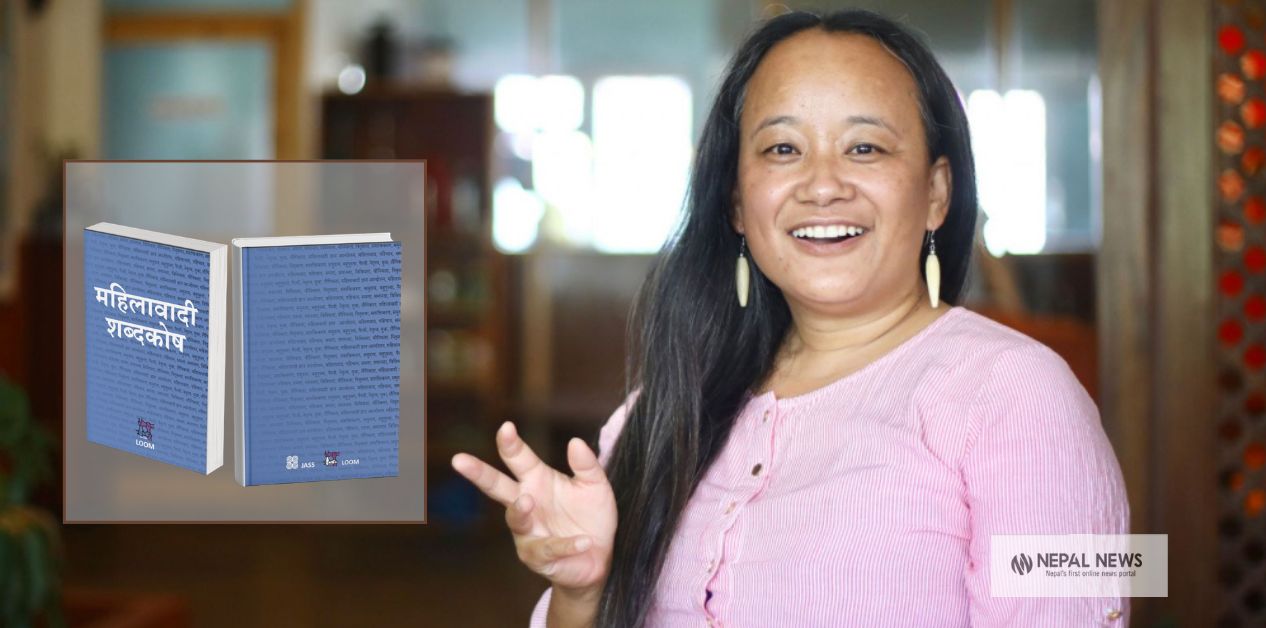
Kailash Rai. Inset: Feminist Movement Builders Dictionary. Photo: Martin Chautari Website
KATHMANDU: Independent researcher, writer, editor, and social activist Kailash Rai has been working for over two decades on issues of gender, social justice, sexuality, minority rights, and Indigenous affairs in Nepal. Adopting an intersectional approach to feminist knowledge construction, she has brought the social, cultural, and political experiences of marginalized communities into public debate through writing, research, and advocacy.
A former vice president of Martin Chautari and co-founder of Indigenous Without Borders, Rai recently engaged in translating and publishing the second edition of the Feminist Movement Builders Dictionary into Nepali. Developed through the collective efforts of feminist scholars, activists, and experts from various countries, this dictionary seeks to reframe existing terminology from a feminist perspective. Below is a conversation between Girish Subedi and Kailash Rai:
How is this dictionary different from others?
This dictionary does not contain the commonly used definitions of words. It includes terms that offer new meanings distinct from patriarchal understandings. These definitions are constructed by placing women’s experiences, perspectives, power, and identity at the center.
The dictionary captures the silenced experiences, thoughts, and knowledge of women—who make up half of the human population—into written definitions. Specifically, it encompasses terms frequently used across non-governmental, academic, and governmental sectors to achieve gender justice. Topics include androcentric perspectives, femicide, gender citizenship, gender identity, ableism, heteronormativity, the care economy, academic debate, ethnicity, feminist intervention, feminist knowledge, and safe spaces.
It helps clarify where, in what context, with what meaning or purpose, and how these words can be used. Its unique aspect lies in refining knowledge gained from other dictionaries and aiding in understanding it through a feminist lens.
Could you tell us about the background of this dictionary?
This dictionary is the Nepali translation of the Feminist Movement Builders Dictionary. It was originally published in English by the organization JASS (Just Associates) in 2012. It was prepared using the collective expertise of feminist educators, experts, and activists across 27 countries in Mesoamerica, Southeast Asia, and Southern Africa. The second edition was published in 2013, and we translated and published that second edition into Nepali.
What significance do you think this holds for Nepali society?
This dictionary helps those active in securing women’s rights and those wishing to adopt feminist concepts to strengthen their ideological presence in the public sphere. It assists their conceptual processes while fortifying feminist resolve.
Additionally, it helps foster a shared and accurate understanding among people working with diverse perspectives across law, policy, education, society, the market, the economy, governance, research, and social transformation. Broadly speaking, it helps render debates on gender justice and social justice robust, logical, and clear.
It enables us to understand and explain the gendered conditions of Nepali society through words and meanings, given the scarcity of such materials here. The language and discourses required for gender studies in Nepal are currently in development; this book contributes further to that process. Therefore, it is equally useful for the general reader as it is for women’s rights activists and feminists.
Why is the creation of a women-centered dictionary necessary?
Feminist knowledge possesses its own epistemology and intellectual life. When people fail or refuse to understand that intellectual life, a misconception arises that advocating for women’s rights or maintaining a critical consciousness spoils family relationships. Misleading claims are also made that discussing these matters causes community strife or fractures the country.
To counter such gendered and hostile narratives, possessing knowledge of feminist theory and its epistemology is essential. Thus, understanding the vitality and essence of feminist knowledge requires its own grammar, vocabulary, and definitions. Dictionaries built from a feminist perspective are necessary to fulfill this need.
In your view, how do linguistic flaws or biases affect the understanding of gender, and what can be done to change this?
Most of the language we use daily is not women-friendly. Certain proverbs, idioms, and metaphors belittle and insult women from marginalized communities. Such sharp language and words lodge themselves powerfully in the mind and can slip out in speech at any moment.
When a woman falls victim to sexual violence, harassment, or rape, society still does not take the practice of blaming the victim seriously. Some even find it entertaining or normal, which emboldens perpetrators to speak without restraint. As this cycle repeats, misogynistic thinking gains social and cultural legitimacy.

Kailash Rai. Photo: Martin Chautari Website
This represents a negative mindset in our society. By treating such matters as normal and ignoring them, we deny women their self-respect, privacy, and selfhood, refusing to acknowledge their personal existence.
This perpetuates a psychology that normalizes misogynistic language and behavior across generations. Dismantling this mindset requires a feminist perspective and critical awareness.
What is the need for feminist knowledge construction in Nepal, and what role can this dictionary play?
We express our ideas by seeing, listening, speaking, reading, and writing. These are the processes and mediums of knowledge production. However, women were excluded from these processes and mediums for a long time.
It has been barely a century since women began raising their voices for themselves. Yet, their experiential and objective points of view are still not easily accepted. Creative critiques and analyses made by women regarding male-centered values are either ignored or dismissed as “extremist.”
Women’s rights activists face these difficult circumstances within families, society, and at the state level. When women are ideologically isolated while resisting these barriers, they feel weakened. In such situations, instilling the realization that “I am a human being, I have ideas, and I am not alone in these thoughts” is vital.
To foster that realization, it is essential for individuals to convey to one another, “I am with you,” which happens through shared understanding and the exchange of ideas. Connecting the shared pain and experiences of a woman struggling anywhere in the world with a woman in Nepal to inspire the feeling that “we are struggling for the same goal from different places” is necessary. For this, the work of feminist knowledge construction must continue continuously in Nepali society.
Women must bring their ideas forward. Works like this will continue to energize them to live with their convictions. In this context, Loom Nepal, an organization active in intergenerational feminist knowledge construction, published this feminist dictionary to sustain conceptual energy among women’s rights activists in Nepal.
August 16, 2026
Source: https://english.nepalnews.com/s/interview/language-is-not-neutral-in-the-struggle-for-equality/
About the Author
More Blogs